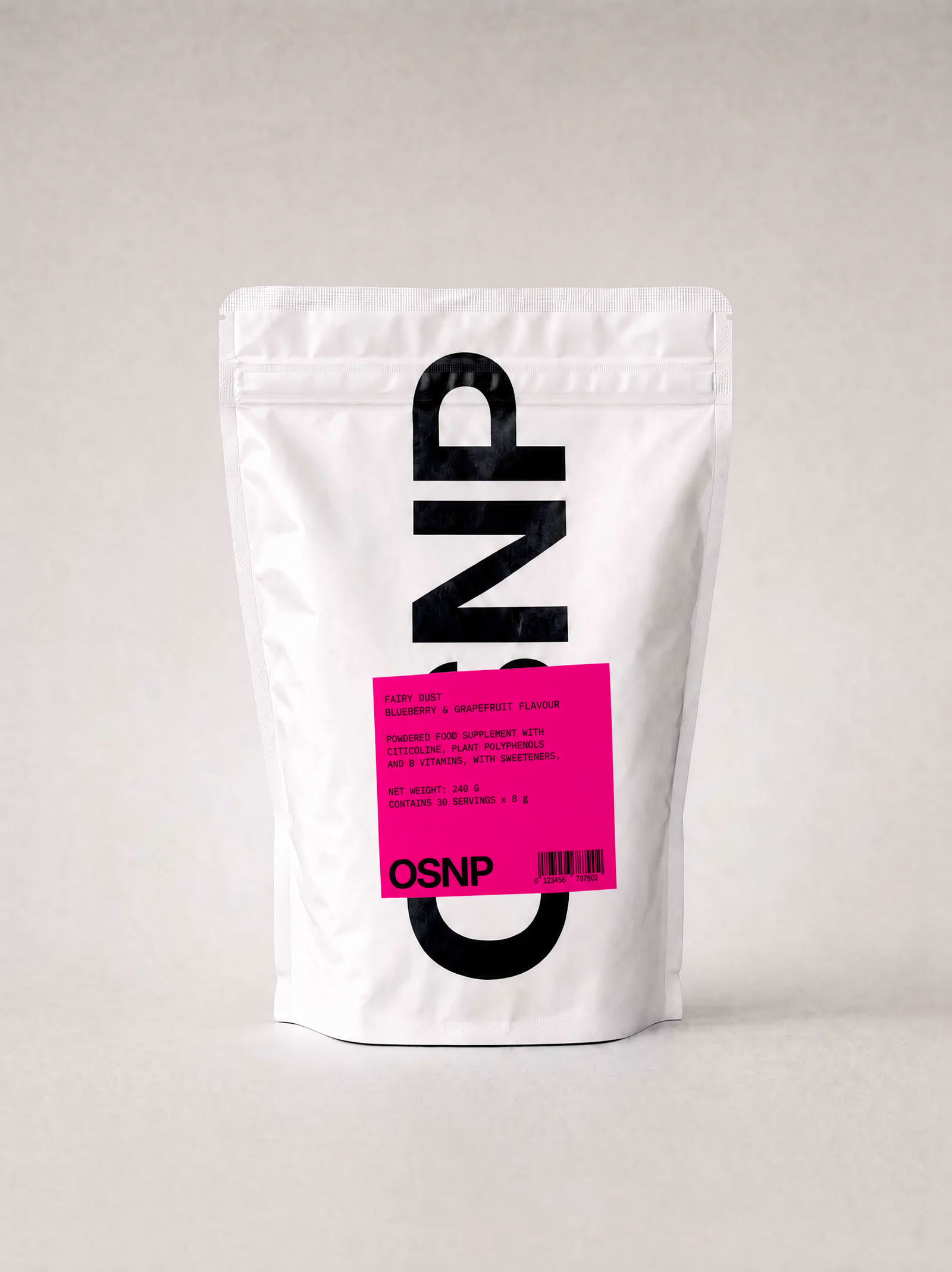
Fairy dust
SUPPLEMENTS

JUST CREATINE

Creatine monohydrate, micronised. Nothing else in the bag. One of the most studied compounds in all of nutrition science.
  • ~5 g a day. Saturates muscle for most people in 3–4 weeks. No loading required.
  • Micronised, so it dissolves instead of sitting at the bottom of the glass.
  • Made in China, packed in Slovenia. We name both, and publish the certificate of analysis for the batch you're buying.
CREATINE MONOHYDRATE (MICRONISED)  |  5 G / DOSE  |  186 DOSES (930 G)  |  UNFLAVOURED
COST PER DOSE
0,0 € / DOSE
COST PER MONTH
0,0 € AT 5G / DAY
POUCH LASTS
186 DAYS AT 5G
ONE-TIME
Single pouch
Shipping
€0,00
First batch is on its way to the warehouse. Back shortly.
No subscription. No auto-charge. Returns and what to expect → see Before you buy.
INGREDIENTS & SOURCING
Every input. Published.
NUTRITION FACTS
INGREDIENT PER DOSE [5 G] % NRV*
CREATINE MONOHYDRATE 5000 MG //
(OF WHICH CREATINE) 4400 MG //
*NRV = Nutrient Reference Value. // = none established for creatine.
One ingredient: creatine monohydrate, and nothing else. Free of all 14 EU-listed allergens (manufacturer's Annex II statement on file).
Creatine Monohydrate (micronised)
STRENGTH | POWER OUTPUT | RECOVERY
5000 mg
Here's the whole chain. Where it's missing a document, we say so.
Active ingredient: creatine monohydrate (micronised, 200 mesh)
Manufacturer: Inner Mongolia Chengxin Yongan Chemical Co., Ltd.
Location: Alxa, Inner Mongolia, China.
Supplier: HSH Chemie d.o.o., Zgornji Brnik 390, 4210 Brnik-Aerodrom, Slovenia.
Batch on sale: lot F20250606C · manufactured 2025-06-07 · best before 2027-06-06.
CoA (USP methods)
Packing & finishing
Packing: ADOMA proizvodnja, trgovina in storitve d.o.o.
Location: Majhnova ulica 15, 4264 Bohinjska Bistrica, Slovenia.
Standard: IFS Progress certified (Quality Austria, score 98.48%, valid to Feb 2027).
Certificate
Made in China. We're saying it out loud.
Almost all the world's creatine is manufactured in China. Ours included. Often the product hiding behind "European-quality formula" is sourced from one of the same handful of plants located in China. What a brand can actually control isn't the country of origin, but rather which supplier, what the ingredient was tested for, and how the final product is made. So that's what we show you.
LOT F20250606C: CERTIFICATE OF ANALYSIS
Full sheet
TEST RESULT SPEC
ASSAY (CREATINE MONOHYDRATE, DRY BASIS)> 99.5%99.5–102.0%
CREATININE22 ppm≤ 100 ppm
DICYANDIAMIDE48 ppm≤ 50 ppm
DIHYDROTRIAZINENOT DETECTED≤ 0.0005%
LEAD0.001 ppm≤ 0.1 ppm
HEAVY METALS (TOTAL)CONFORM≤ 10 ppm
MICROBIALS (E. COLI, SALMONELLA, S. AUREUS)NOT DETECTED
PARTICLE SIZE73% through 200 mesh≥ 70%
The change log. Every mistake, fix and update to this product, dated and public.
/ TYPE / DATE / TOPIC

Just before Just Creatine went live, we found a problem with the pouches. The manufacturer had sealed a batch poorly, and powder was leaking from the bottom seam. We pushed the launch back to deal with it.

We hadn't been checking pouch quality ourselves before this. It didn't occur to us that we needed to when ordering from a respected and supposedly very reliable manufacturer, so part of the responsibility for the delay sits with us too. We're fixing it as fast as we can, and we introduced our own rigorous pouch checks as a standard part of how every batch gets approved.
FORMULATION
The science, in the open

We make no health claims, on purpose. The EU keeps a register of pre-approved sentences a brand is permitted to recite about a supplement. Creatine gets exactly two, but you will never see our product carry them. Because the whole system is a charade; a permission slip dressed up as rigour.

Being allowed to print an approved sentence doesn't make a product work. The evidence was never in what the bureaucrats put their legal stamp on. The evidence is the research data behind the product, linked and explained right here.

Read what the literature shows and make an informed decision for yourself. We'd rather hand you the evidence than recite you a line we don't even agree with, just because the regulator signed it off.

All your cells, especially muscles and other energy-intensive tissue, hold a pool of creatine, and part of it is phosphorylated into phosphocreatine, which acts as the cell's energy reserve. During high energy demand, like for example an all-out effort such as sprinting or lifting weights, phosphocreatine donates a phosphate group to ADP to regenerate ATP, the molecule a cell has to spend to do the work. A cell carrying more creatine can hold a larger phosphocreatine reserve, and that's the biochemical rationale for why supplementing creatine is more often than not a pretty good idea.

Muscles hold most, about 95% of all body creatine, but it's not the only tissue that needs it. The brain and nervous system, the heart, the kidneys, basically every tissue with a high energy turnover runs on the same phosphocreatine system. The more energetically demanding the tissue, the more it relies on creatine. And the more creatine that tissue carries, the more robust it is: better able to hold up under stress, fatigue, and crises. Muscle is just the one we can saturate most easily, while other organs, especially the brain, need stronger supplemental encouragement.

CITED: KREIDER ET AL., 2017 ↓
THE ENERGY SYSTEM, IN NUMBERS
TYPEAnaerobic alactic
DURATION~8–12 s of max-intensity effort
WHEN IT DOMINATESShort maximal bursts (a sprint, a near max lift)
RECOVERY3–5 min between efforts
MUSCLE STORAGE~120 mmol/kg dry muscle
CITED: KREIDER ET AL., 2017 ↓

For muscle, the dose is settled: 3–5 g a day saturates your stores in 3–4 weeks. 5 g is a clean default, loading just gets you there faster (Kreider 2017; Hultman 1996).

However, 3–5 g is a floor, not a ceiling. Sometimes 5 g isn't the number:

  • Body size. Recent research scales the dose to ~0.1 g/kg/day (Candow 2024), meaning a 90 kg person lands nearer 7–9 g.
  • Beyond muscle. The brain takes up creatine slower than muscle, so it needs more, and longer. Brain creatine saturation is shown at sustained doses around 10–20 g/day. In a scenario of depleted brain creatine, which happens for example with acute sleep loss, a single ~0.35 g/kg dose was shown to normalise brain creatine. The payoff with high-dose creatine is clearest under stress (sleep loss, illness, ageing), not as an everyday lift when you're well-rested and in good general condition (Fabiano 2025; Roschel 2021). Bone may respond to higher doses too, but only with resistance training (Candow 2024), and the research on this is still considered promising, not as settled.
  • Older age. Past 55, the evidence that exists for higher-dose creatine is in combination with progressive resistance training. The training is what drives the benefits, whereas a bigger scoop of creatine amplifies them (Kreider 2017; Candow 2024).
CITED: CANDOW ET AL. 2024 · KREIDER ET AL. 2017 · HULTMAN ET AL. 1996 · FABIANO & CANDOW 2025 · ROSCHEL ET AL. 2021 ↓
DOSE, BY GOAL
MUSCLE SATURATION3–5 g/day, loading optional: Settled
SCALING TO BODY SIZE~0.1 g/kg/day: Supported
BRAIN UPTAKE10–20 g/day, sustained: Promising
BONE (+ TRAINING)>10 g/day, with resistance training: Emerging
ADULTS 55+ (+ TRAINING)>5 g/day, with resistance training: Supported
CITED: CANDOW ET AL. 2024 · KREIDER ET AL. 2017 · HULTMAN ET AL. 1996 · FABIANO & CANDOW 2025 · ROSCHEL ET AL. 2021 ↓

Creatine monohydrate is by far the most studied form there is, and it's not even close. Also, it's the only form that actually "survives" the examination. None of the "upgraded" forms, hydrochloride, ethyl ester, buffered (Kre-Alkalyn), magnesium chelate, nitrate, that are pitched as more soluble, more bioavailable, effective at a lower dose, have ever beaten monohydrate in a fair head-to-head at an equal dose.

Some are actually much worse: for example ethyl ester, which converts to creatinine, the inactive waste product, before your muscles can use it. The chemists who pinned it down concluded it's "a pronutrient for creatinine rather than creatine" (Giese & Lecher 2009).

"More soluble" doesn't mean "better absorbed" when monohydrate is already nearly 100% absorbed. What the alternatives reliably deliver is a price two to ten times higher.

We use micronised monohydrate. Smaller particles dissolve better. That's the only "upgrade" worth paying for. Simply because it makes mixing it in liquid less of a chore.

CITED: KREIDER ET AL. 2022 · JÄGER ET AL. 2011 · ANTONIO ET AL. 2021 · GIESE & LECHER 2009 ↓
ALTERNATIVE FORMS
HCLNo better absorbed
ETHYL ESTERDegrades to creatinine
BUFFEREDNo buffering advantage shown
MALATE / CITRATELess creatine per gram
PRICE PREMIUM2–10× monohydrate
CITED: KREIDER ET AL. 2022 · JÄGER ET AL. 2011 · ANTONIO ET AL. 2021 · GIESE & LECHER 2009 ↓

A loading phase, about 20 g a day (split into four 5 g doses) for 5–7 days, fills your muscle stores faster. Skip it and just take 3–5 g a day, and you land at the exact same saturation in three to four weeks. Destination is the same, it just takes a bit longer.

Skip it if you can't be bothered; most people do. Also worth knowing is that loading is the reason for most of the creatine-associated GI discomfort people have been reporting after starting supplementation. If that's you, start on the lower end of 3–5 g and increase the daily total gradually. Splitting the total into two or more doses, with a few hours in between them, may also smoothen the transition.

The 3–5 g here is the muscle baseline. It saturates most people's muscle stores. Not all though; some bodies and goals need more (see "Why 5 grams"). Loading only changes how fast you reach muscle saturation.

CITED: HULTMAN ET AL. 1996 · ANTONIO ET AL. 2021 ↓
PROTOCOLS
LOAD (OPTIONAL)20 g/day (4 × 5 g) × 5–7 days = 7–10 days to muscle saturation
OR SKIP3–5 g/day from day one = 3–4 weeks to muscle saturation
MAINTENANCE3–5 g/day, forever
WASH-OUT~4 weeks
CITED: HULTMAN ET AL. 1996 · ANTONIO ET AL. 2021 ↓
EVIDENCE
Studies cited
Creatine monohydrate is one of the most studied supplements in sport. Over 500 peer-reviewed publications and counting (Antonio et al. 2021). Here's what we actually lean on, and you can read each one.
International Society of Sports Nutrition position stand: safety and efficacy of creatine supplementation in exercise, sport, and medicine.
J. Int. Soc. Sports Nutr. · ISSN position stand
WHAT IT IS
The official position stand of the International Society of Sports Nutrition. It is the field's consensus document, written by a panel of leading creatine researchers and peer-reviewed by the society. About as authoritative as sports-supplement science gets.
WHY WE CITE IT
Our backbone for the mechanism, the safety record, and baseline dosing (load ~0.3 g/kg/day, maintain 3–5 g/day). When we say something is "settled," this is usually why.
IN SHORT
Creatine monohydrate is the most effective legal supplement for high-intensity performance and lean mass, safe up to 30 g/day for 5 years, with a growing list of clinical uses. Most of the fears around it are myths.
CITED IN
01 ·PHOSPHOCREATINE SYSTEM
02 ·WHY 5 GRAMS
DOI →
Bioavailability, efficacy, safety, and regulatory status of creatine and related compounds: a systematic review.
Nutrients · systematic review (PRISMA)
WHAT IT IS
The definitive forms audit, from Richard Kreider's sports-nutrition lab at Texas A&M. Catalogues every marketed creatine "form" against the actual evidence.
WHY WE CITE IT
The backbone of "why monohydrate." It grades each alternative (HCl, ethyl ester, buffered, nitrate, salts) and shows none beats monohydrate at an equal dose.
IN SHORT
Monohydrate is ~100% bioavailable, the only form with global regulatory approval, the gold standard. The "upgrades" are marketing; some are demonstrably worse.
CITED IN
03 ·WHY MONOHYDRATE
DOI →
Analysis of the efficacy, safety, and regulatory status of novel forms of creatine.
Amino Acids · review
WHAT IT IS
The 2011 forerunner to the 2022 forms review, same core authors (Jäger, Kreider). The first systematic look at whether the "novel" creatine forms hold up.
WHY WE CITE IT
It established, a decade before the 2022 update, that the newer forms have little-to-no evidence of being better than monohydrate. It shows that the marketing has failed the test repeatedly.
IN SHORT
Monohydrate raises muscle creatine 15–40%, is ~99% absorbed or excreted (not destroyed in digestion), and has no medically significant side effects; the newer forms can't match that record.
CITED IN
03 ·WHY MONOHYDRATE
DOI →
Muscle creatine loading in men.
J. Appl. Physiol. · clinical trial (muscle biopsy)
WHAT IT IS
The original muscle-loading study: Hultman and Greenhaff's Nottingham group, the work that defined how creatine dosing is done. 31 men, real muscle biopsies.
WHY WE CITE IT
The proof behind "loading is optional." It mapped both roads to saturation, and it's why we can say 3–5 g/day gets you there without a loading week.
IN SHORT
20 g/day for 6 days raises muscle creatine ~20%; 2 g/day then maintains it; and 3 g/day alone reaches the same level over ~28 days. Same destination, different speed.
CITED IN
02 ·WHY 5 GRAMS
04 ·LOADING IS OPTIONAL
DOI →
Whether one creatine dose fits all.
Adv. Exerc. Health Sci. · narrative review
WHAT IT IS
The paper that legitimises individualised dosing. "Whether one creatine dose fits all" is the actual title. Lead author is Darren Candow, the guy who is to creatine science what Taylor Swift is to pop music.
WHY WE CITE IT
It backs "5 g is a floor, not a ceiling." It's where 0.1 g/kg and the higher brain/bone doses come from, while still affirming 3–5 g saturates muscle.
IN SHORT
The dose depends on the tissue, the person, and their specific circumstances or goals. Muscle is settled at 3–5 g/day; bone needs more plus exercise; brain needs much more or much longer.
CITED IN
02 ·WHY 5 GRAMS
DOI →
Common questions and misconceptions about creatine supplementation: what does the scientific evidence really show?
J. Int. Soc. Sports Nutr. · expert-consensus review
WHAT IT IS
Twelve of the field's most-published creatine researchers answering the twelve questions people actually ask: kidneys, hair loss, water weight, loading, kids. The myth-busting reference.
WHY WE CITE IT
Our source for "loading is optional," the responder context, and the "over 500 studies" figure. Also where the common fears get dismantled with citations.
IN SHORT
Creatine doesn't wreck your kidneys, cause baldness, dehydrate you, or make you fat; loading isn't required; monohydrate is the best-value form. Decades of evidence, plainly stated.
CITED IN
04 ·LOADING IS OPTIONAL
Q02 ·WHAT IF IT DOESN'T WORK?
DOI →
Acute creatine loading and skeletal muscle metabolic and performance responders vs. non-responders.
J. Strength Cond. Res. · clinical study (n=11, muscle biopsy)
WHAT IT IS
A small, careful biopsy study profiling some people respond to creatine and some barely do. The paper behind the "responder / non-responder" idea.
WHY WE CITE IT
The honesty behind Q2: proof that creatine genuinely does less for some people, and the assumed biology of who. We'd rather show you this than promise it'll work for you.
IN SHORT
Of 11 men, ~a third were strong responders and ~a third barely moved. Non-responders started with higher muscle creatine, fewer fast-twitch fibres, and less muscle; and they saw no strength gain.
CITED IN
Q02 ·WHAT IF IT DOESN'T WORK?
DOI →
Non-enzymatic cyclization of creatine ethyl ester to creatinine.
Biochem. Biophys. Res. Commun. · lab chemistry (NMR)
WHAT IT IS
A 2009 analytical-chemistry study of what actually happens to creatine ethyl ester under body conditions. Settles, at the molecular level, whether CEE delivers creatine at all.
WHY WE CITE IT
The proof behind our ethyl-ester line: that CEE turns into creatinine, not creatine.
IN SHORT
It shows CEE cyclises to inactive creatinine as the exclusive product, near-instantly at body pH (7.4). The authors call it "a pronutrient for creatinine rather than creatine," with no ergogenic effect expected.
CITED IN
03 ·WHY MONOHYDRATE
DOI →
Creatine and the brain: a dosing question.
J. Psychiatry Brain Sci. · mini-review
WHAT IT IS
A 2025 review making the case for higher creatine doses when the brain is the target, again from Candow's orbit. The current state of the dosing question for "creatine and the brain."
WHY WE CITE IT
The basis for the brain numbers in §02: that the brain needs more, and longer, than muscle, and where the 10–20 g range comes from.
IN SHORT
The brain resists creatine uptake, so standard 3–5 g doses often don't move it; 10–20 g/day (or short high doses) do, with the clearest payoff under metabolic stress. Promising, not yet settled.
CITED IN
02 ·WHY 5 GRAMS
DOI →
Creatine supplementation and brain health.
Nutrients · review
WHAT IT IS
A 2021 review of the human evidence on creatine and brain health: cognition, mood, brain injury. Sober and gap-aware, not hype.
WHY WE CITE IT
Our check on overclaiming the brain story. It's the source for "clearest under stress, not an everyday lift."
IN SHORT
Creatine raises brain creatine only ~5–10% (less than muscle) and helps cognition mainly under stress, such as in sleep loss, hypoxia, mental fatigue. In rested, healthy people the effect is inconsistent.
CITED IN
02 ·WHY 5 GRAMS
DOI →
The metabolic burden of creatine synthesis.
Amino Acids · quantitative review
WHAT IT IS
A metabolic accounting of what it costs your body to make its own creatine, from John Brosnan's group. It puts hard numbers on a process most people wave past.
WHY WE CITE IT
It's behind the dietary case in Q1: that synthesising your own creatine is metabolically expensive, especially for your methyl groups.
IN SHORT
Making creatine consumes ~40% of the body's daily labile methyl groups (its single largest user), plus 20–30% of available arginine. The burden falls hardest on people who eat little meat and make all their own.
CITED IN
Q01 ·IS THIS RIGHT FOR YOU?
DOI →
Perspective: creatine, a conditionally essential nutrient.
Advances in Nutrition · perspective
WHAT IT IS
A perspective arguing creatine should be reclassified as a "conditionally essential" nutrient, based in the evidence showing that the body's own output often isn't enough. Co-authored by Sergej Ostojic and Scott Forbes, two leading voices on creatine in nutrition.
WHY WE CITE IT
The source for Q1's "conditionally essential" line, with the honest disclaimer that it's an argument, not settled fact.
IN SHORT
For vegans, the elderly, and some clinical groups (arguably the general population too), endogenous creatine falls short of need, making dietary creatine important for health. Although formal recognition still lacks an RDA and food-composition data.
CITED IN
Q01 ·IS THIS RIGHT FOR YOU?
DOI →
DOSING
Your dose. Not ours.

For muscle, 5 g a day covers most people, which makes it a standard dose: the general recommendation given when the other factors deciding an individual's true dose are unknown. That is why you see 5 g thrown around most often.

For the cases where you want to know what a true recommended dose is once the key factors influencing it are accounted for, we built you the tool below. Tell it your weight, pick what you're dosing for. This tool is for informational purposes only and must not be considered medical advice nor a nutritional recommendation. Before starting any supplement or making changes to your diet always consult your doctor. Obviously.

YOUR BODYWEIGHT [KG]
kg
40 70 100 130 150
DOSING PROTOCOL
Standard. 5 g a day. Full muscle saturation in 3–4 weeks. Pick a time and stick to it; timing around training doesn't meaningfully matter. Want to see what the dose by body size would be instead? Switch on scale-by-weight on the left.
YOUR DAILY DOSE
5 G/DAY
SCOOPS PER DAY
1 × 5G
POUCH LASTS
186 DAYS
COST AT YOUR DOSE
0,27 €/DAY
REVIEWS
No reviews yet

There are none to show, so this space stays empty rather than filled with something we wrote. When people do write them they go to Trustpilot, who verify them and will not let us edit or delete what lands there.

Check for yourself →
QUESTIONS
Before you buy
TWO HONEST CASES. NEITHER OVERSOLD.

The training case. If you do any repeated high-intensity work, such as lifting, sprinting, team sport, creatine has the best evidence-to-cost ratio of anything in the category. Decades of trials, hundreds of studies, a mechanism that's actually understood. Nothing else comes close on proof per euro.

The dietary case. Your body turns over roughly 2 g of creatine a day. About half you make yourself (in the liver and kidneys, from amino acids); the other half is meant to come from meat and fish. The fact is that making your own creatine isn't free: it's the single biggest user of your body's methyl groups, about 40% of your daily budget (Brosnan et al. 2011). Eat little or no meat and you run lower; some researchers now argue creatine is a "conditionally essential" nutrient on exactly that basis (Ostojic & Forbes 2022). It is not yet a settled matter, but it isn't a fringe one either. Both papers are in the references below.

Who it's probably not for. If your diet's a mess, your sleep is consistently bad, or your training is inconsistent, then fix those first. No amount of creatine can paper over a collapsing foundation.

Who it's for. Someone whose basics are covered, who wants to remove a variable rather than add a magic ingredient.

Two parts, and we're going to be straight about both.

Your legal right. Changed your mind and the bag's still sealed? You have a 14-day right of withdrawal under EU consumer law. You get a full refund, no reason needed. That's your right, not our generosity. And if it turns up damaged, or we ship the wrong thing, or the product itself is faulty, we replace it. It's basic fairness.

What we don't do is a "satisfaction guarantee." Because "money back if you don't feel it" is a sales tactic, and we don't run those. Here's what we'll give you instead: the truth about why it might not move the needle for you. A real share of people are "non-responders"; their muscle creatine is already near full, often because they eat a lot of red meat or fish, and they get little extra from supplementing (Syrotuik & Bell 2004). That's biology, and you deserve to know it before you pay, not after. If your diet already has this covered, you may simply not notice a strong effect.

One caveat on that "you may not need it" is that it's a muscle statement. The brain plays by different rules. A brain topped up with creatine isn't something you feel on a normal day; where the reserve earns its keep is the bad ones, like a stretch of almost no sleep, say. And even then you might not feel it working: you'd just hold steadier while someone running on empty starts to fade. The research points this way (see "Why 5 grams"), but it's a buffer you can't easily perceive. It's promising, not a promise.

The product isn't. The way we operate around it is.

We don't list a study and call it proof. We link the actual paper so you can see what it shows, what it doesn't, and where the authors themselves drew the line.

The "purest creatine" competition is a charade. "Pharmaceutical-grade," "ultra-pure," "next-generation," "99.99%"; all of this is a contest brands win to justify the price, not a difference you can feel or, usually, even check. Any creatine monohydrate whose certificate says it's creatine monohydrate is creatine monohydrate.

So we don't claim purest. We publish the actual certificate and let you read it. Then go ask a brand selling "ultra-pure" for theirs, and see if you get a number back. And if you do: good luck finding one that's meaningfully cleaner than the Chinese creatine you were taught to look down on.

No flash sales, no countdown timers, no discount codes. And it's manufactured in China, like essentially every creatine in this category. We're just the ones saying so.

Honestly: a few weeks, minimum. There's no faster version. Creatine works by saturating your muscle stores, and that takes time however you dose it.

At 5 g/day: full saturation in 3–4 weeks. Pick a time of day and stick to it.

Loading (20 g/day, split, 5–7 days): same endpoint, shorter runway, slightly more GI risk.

And set the expectation honestly: you won't feel a "surge." Creatine isn't a stimulant. It enlarges the reservoir of fast energy your working muscle can draw on. You might notice it as a little less drop-off in your last sets. Or you might not feel it at all and only see it in the numbers over time. That's what the evidence actually supports.

And there's a longer horizon worth naming. A lot of what nutrition does is cumulative. You probably won't feel it tomorrow or in a few weeks. It's a benefit you bank over years of doing it right, and only for as long as you keep it up. Creatine's brain side may belong in that category: less an effect you notice next week than a reserve you keep topped up for the long run. And we have to be honest about it being a long bet. Consider it an education we make for the product. It's not a claim or a promise we can give you an absolute guarantee on. The honest version is in Why 5 grams above.

Here it is, plainly.

It's made in China. Like essentially all creatine. The plants that make it at scale are there, and ours is Inner Mongolia Chengxin Yongan. We're not hiding it behind "European standards" language: the certificate's right there. If that's a dealbreaker, by all means go find a brand that won't tell you where theirs is really from (probably also China), or one that plays dumb and forgets to mention its "ultra-pure" powder isn't meaningfully purer than everyone else's.

We can't tell you it'll work for you. The research is real, the mechanism is understood. What we can't tell you is whether you're a responder, or whether your diet already covers your needs.

We won't chase you with discount emails. You buy more when you need more. That's it.

We might tell you not to buy it. Ask us whether creatine makes sense for your situation and if the honest answer is no, that's what you'll get. The education is the actual product. Just Creatine is just the proof we'll hold ourselves to the same standard we ask you to.

Every change to this product lands in the change log before it lands anywhere else.

ORDER
One pouch. One price.
One bag. 930 g. 186 doses at 5 g. No subscription, no auto-charge. Lasts about six months at 5 g a day.
ONE-TIME
Single pouch
Shipping
€0,00
First batch is on its way to the warehouse. Back shortly.
Returns, straight. Sealed and changed your mind? 14-day EU withdrawal, full refund. Damaged, wrong, or faulty? We replace it. We don't run a "satisfaction guarantee". Creatine doesn't work for everyone, and pretending a refund fixes that would be the kind of sales theatre we're against. Why it might not work for you is in Before you buy.
Fairy dust